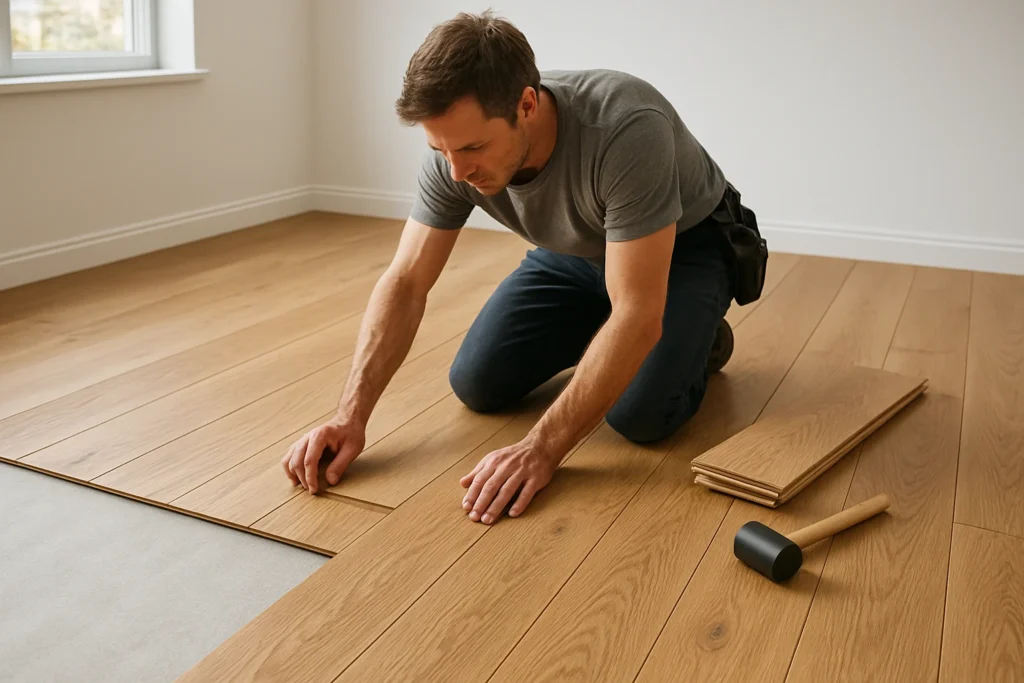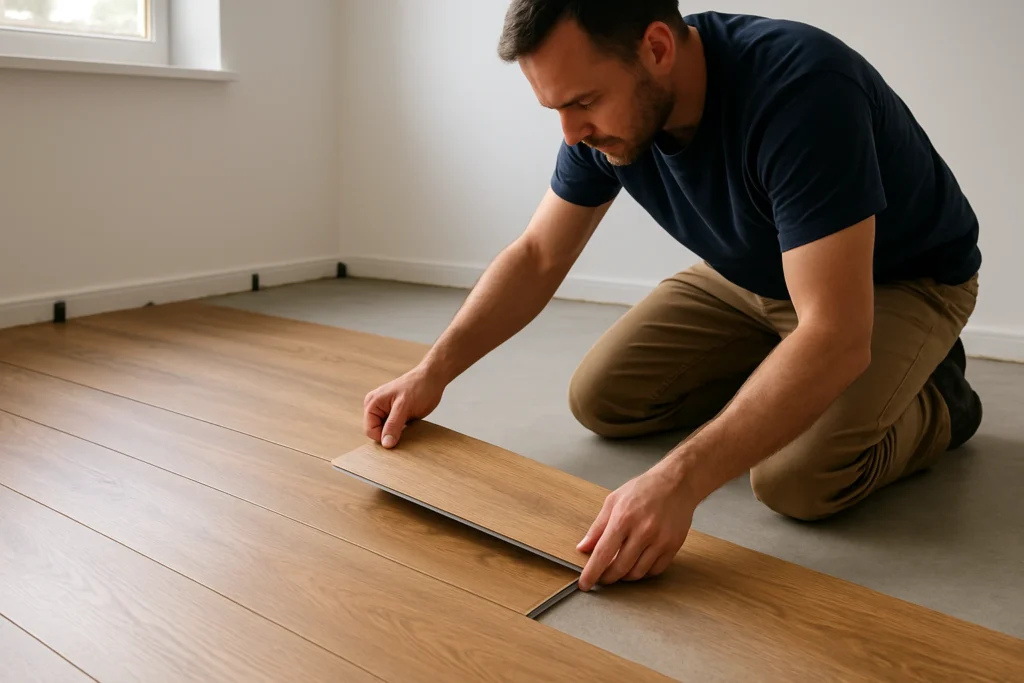


LVP flooring means luxury vinyl plank flooring, a layered floor made mainly from vinyl and designed to look like wooden boards. It has a printed wood design beneath a clear wear layer and comes in flexible glue-down planks or rigid click-lock planks. LVP is easy to clean and handles everyday spills well, but it can scratch, cannot be sanded like wood, and does not make the floor beneath it waterproof.
What Is LVP Flooring Made Of?
LVP flooring combines a protective surface, a printed design, and a supporting core. The word “luxury” describes a product category, not a fixed quality standard, so two floors sold as LVP can perform quite differently.

Most planks have these parts, although the exact layers vary by product:
- Surface coating: A thin finish that helps resist stains and light scuffs.
- Wear layer: A clear protective layer above the printed design. Once damage reaches the print, polishing will not restore the wood pattern.
- Design layer: A printed image that gives the plank its wood colour, grain, and knots.
- Core and backing: The body of the plank, sometimes with an attached pad underneath.
Flexible LVP usually sticks to the prepared base with adhesive. Rigid LVP often uses click-lock edges, which join the boards into a floating floor that rests on the base rather than being glued to it.
You may also see SPC and WPC on the box. SPC means stone plastic composite, a dense, rigid core made with mineral filler and plastic. WPC commonly means wood plastic composite and usually describes a lighter, foamed core, though the exact mix varies by brand. Neither term means the surface is real wood.
When browsing Online Flooring, compare the product specifications rather than relying on the word “luxury”. The core, wear layer, fitting method, and warranty tell you much more about the floor than its name.
How Does LVP Compare with LVT, SPC, Laminate, and Wood?
LVP describes the plank format, while SPC describes a type of core. Laminate and real wood are different from vinyl, even when all three floors have a similar oak finish.

| Flooring Type | What It Means | Main Advantage | What to Check |
|---|---|---|---|
| LVP | Vinyl flooring in wood-style planks | Wood appearance with simple day-to-day care | Wear layer, core, and fitting requirements |
| LVT | Luxury vinyl tile, often used for stone or tile formats | Similar vinyl benefits in different designs | Some suppliers use LVT as an umbrella term that includes planks |
| SPC | A rigid mineral-filled vinyl core | Firm feel and good dimensional stability | Still needs a flat base and room to expand |
| Laminate | A printed surface over a fibreboard core | Often good scratch resistance for the price | Water resistance varies, especially at joints and edges |
| Engineered Wood | A real wood surface over layered backing | Genuine wood grain and feel | Moisture limits and whether the top layer allows sanding |
| Porcelain Tile | Fired ceramic flooring | Strong resistance to water, heat, and surface wear | Hard feel underfoot, grout care, and fitting cost |
A floor can be both LVP and SPC because one term describes its shape and the other describes its core. Our SPC flooring vs LVT flooring comparison explains why these labels can overlap.
For a kitchen or entrance, LVP often makes sense when resistance to spills matters more than having real timber. For a dry room where surface scratching is the main concern, compare the actual products rather than assuming vinyl always beats laminate. The vinyl flooring vs laminate flooring comparison covers that choice in more detail.
Vinyl is also not the same as linoleum flooring, which uses ingredients such as linseed oil. If you want a hard surface for a wet or very sunny space, compare LVP with suitable flooring tiles before deciding.
Is LVP Flooring Waterproof, and What Can Damage It?
Many LVP products are sold as waterproof because their vinyl bodies do not swell like a wood-based core when wet. That does not make the joints, room edges, subfloor, or whole flooring system waterproof.
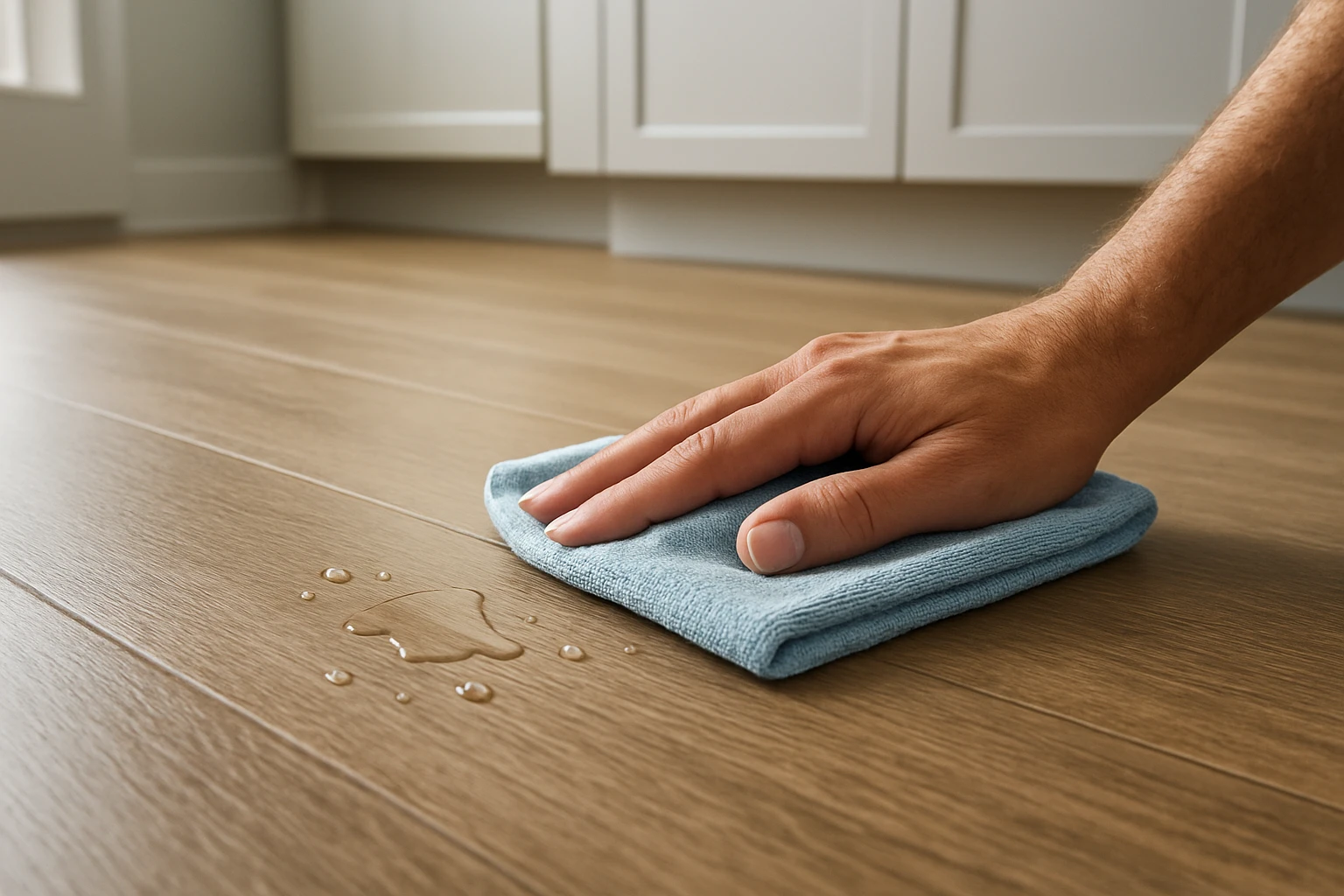
A drink spill that you wipe up promptly is different from a leaking dishwasher that sends water beneath the planks. Trapped water can affect adhesive, damage the base, or encourage mould even when the vinyl itself looks unchanged.
Bathrooms need extra care. Use LVP only where the manufacturer permits it, follow the required steps for sealing the edges, and keep it off shower floors unless a specific approved system allows that use. Waterproof planks are not a substitute for a bathroom waterproofing membrane.
Other limits matter just as much:
- Scratches: Sand beneath shoes or furniture can mark the finish, so entrance mats and felt pads help.
- Dents: Narrow furniture feet and heavy loads can leave marks, especially on softer products.
- Heat and sunlight: Strong sun can cause fading, expansion, or distortion, depending on the product and conditions.
- Surface damage: LVP cannot be sanded and refinished like suitable real wood flooring. A badly damaged board usually needs replacement.
In Dubai, check how well a product handles heat before buying it for a room with west-facing glass. Ask for the product’s temperature limits and use blinds or curtains to reduce strong afternoon sun. A rigid core is not a promise that the floor can handle unlimited heat.
Standard indoor LVP is also not a safe default for an open balcony. Choose purpose-made outdoor flooring that is rated for direct sun, rain, and outdoor temperatures.
How Do You Choose the Right LVP Flooring?
Choose LVP by matching its wear layer, core, and fitting method to the room, rather than buying the thickest plank you can find. Total thickness affects feel and floor height, but it does not tell you how much surface wear the plank can take.

Manufacturer specifications commonly list wear layers in millimetres or mils. A mil is one-thousandth of an inch, not one millimetre, so a 20 mil wear layer is about 0.5 mm thick.
| Room or Use | A Useful Starting Point | What Else Matters |
|---|---|---|
| Bedroom or lightly used room | Around 0.3 mm, often listed as 12 mil | Residential warranty, comfort, and appearance |
| Busy family living area or hallway | Around 0.5 mm, often listed as 20 mil | Surface finish, entrance grit, and furniture protection |
| Office or other commercial room | Often 0.5 to 0.7 mm or more | The stated commercial-use rating, chair castors, and warranty exclusions |
These are starting points for shopping, not guarantees of how long a floor will last. A thicker wear layer does not prevent dents, fix weak joints, or make a poorly fitted floor last.
For office flooring, check whether the product is approved for rolling chairs and the expected foot traffic. A residential warranty may not cover the same floor once it is used in a workplace.
The surface texture matters too. Deep grooves can look convincing, but they may hold more dirt, while a very dark finish can make pale dust easier to see. Look for enough variation between boards so the same knot does not repeat across the room.
Request a free flooring sample and view it flat on the floor in morning light, afternoon sun, and evening lighting. Before ordering, read the product warranty for room restrictions, sunlight limits, fitting conditions, and exclusions rather than judging the product by warranty length alone.
How Much Does LVP Flooring Cost in Dubai?
For early budgeting in Dubai, LVP materials often cost roughly AED 60 to AED 160 per square metre, with straightforward fitting around AED 25 to AED 50 per square metre. These are approximate market ranges, not a quotation, and prices vary by supplier, product, site condition, and location.
| Cost Item | Approximate Budget or Pricing Basis |
|---|---|
| LVP material | Around AED 60 to AED 160 per square metre |
| Basic fitting | Around AED 25 to AED 50 per square metre |
| Combined basic material and fitting | Roughly AED 85 to AED 210 per square metre, before extra work |
| Base repairs or smoothing | Usually quoted after inspection |
| Old floor removal, skirting, and trims | Often separate items |
| Delivery, adhesive, and VAT | Check whether each is included |
For example, take a 40-square-metre room and allow 10 percent extra material for cuts. At an example material price of AED 80 per square metre, 44 square metres would cost AED 3,520. Fitting the actual 40-square-metre floor at an example rate of AED 35 per square metre would add AED 1,400. That gives a total of AED 4,920 before preparation, trims, delivery, and VAT if those are extra.
The right cutting allowance depends on the room shape and laying pattern. A simple rectangle may waste less than a layout with many doorways, while diagonal and patterned layouts often need more material.
Ask for an itemised quote because a low fitting rate may leave out the work that makes the floor perform well. A thin glue-down plank can cost less to buy but need more careful smoothing, so the cheapest box is not always the cheapest finished floor.
Check the return and refund policy before ordering spare packs. Do not assume you can return opened boxes, surplus material, or a special order.
What Makes an LVP Installation Last?
A lasting LVP installation starts with a dry, sound, flat base and the correct fitting method for that product. Click-lock planks are not a fix for an uneven floor, and a waterproof surface does not remove the need to check moisture beneath it.
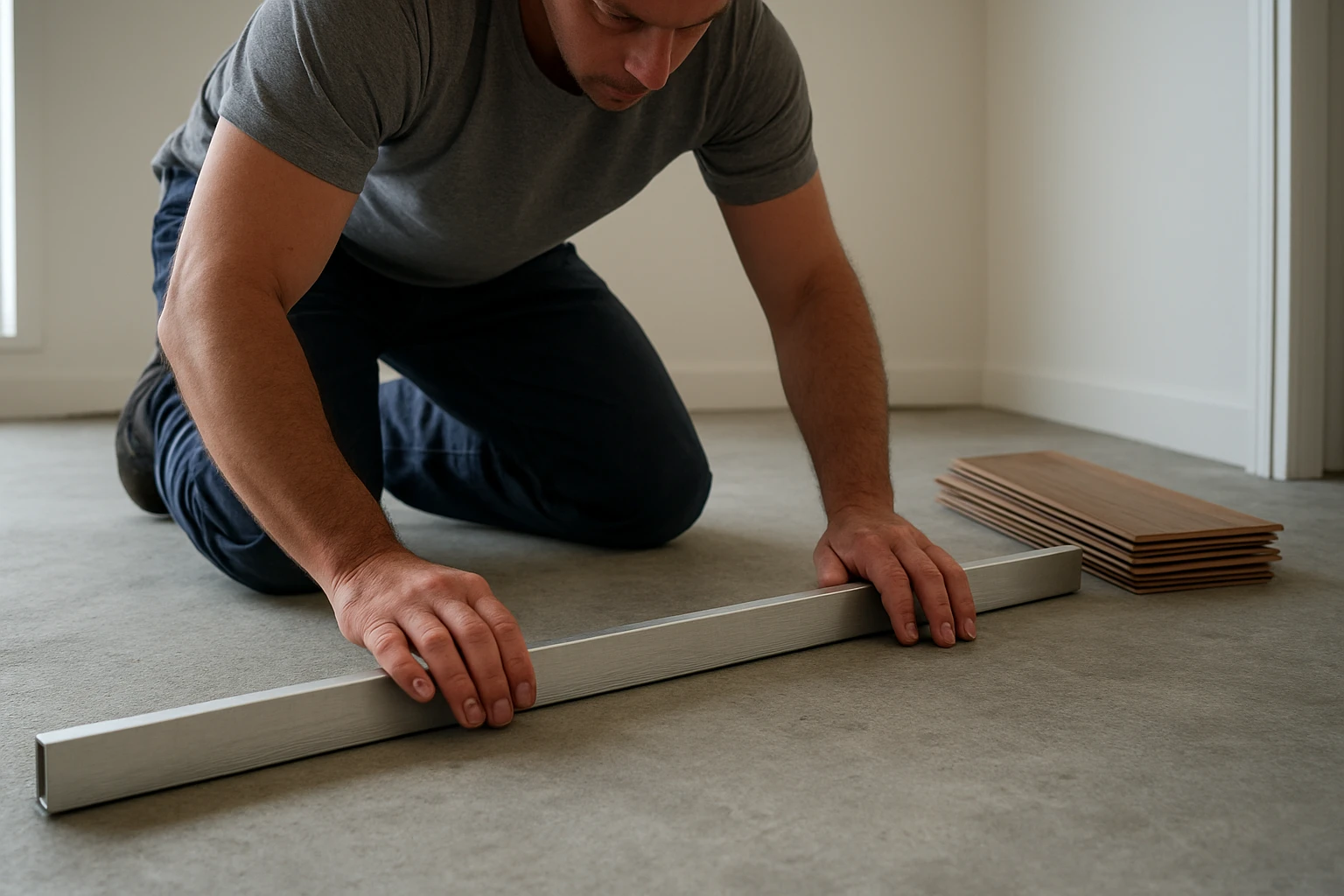
A useful installation plan follows this order:
- Check the base and moisture. Identify loose tiles, cracks, damp areas, and unsuitable old coverings. Use the moisture test required by the flooring and adhesive manufacturers rather than relying on how dry concrete looks.
- Measure flatness. Use a suitable straightedge to check that the base meets the product’s stated limits for unevenness. Flat does not always mean perfectly level, but sudden dips and ridges need attention.
- Confirm finished floor height. Include the plank, approved underlay if needed, adhesive or smoothing layer, and trims. Check door clearance and the height beside other rooms.
- Plan the plank layout. Work out the first and last row widths and the required spacing between end joints before fitting. Avoid a very narrow strip along the most visible wall.
- Fit the floor as specified. Use the approved adhesive for glue-down LVP or leave the required gaps around the edges for click-lock flooring. Allow room for movement around pipes and other fixed points.
- Protect the floor during handover. Allow any adhesive to cure as instructed before moving furniture back, and keep leftover boards for future repairs.
One common mistake is adding soft underlay beneath a click-lock plank that already has a pad. Unless the manufacturer approves it, the extra cushioning can let joints flex too much and fail.
Another mistake is trapping a floating floor beneath fixed cabinetry or screwing through it. Floating planks need room to move, so follow the product’s rules around kitchen units, islands, and partitions.
For flooring installation in Dubai, ask who is responsible for moisture testing, smoothing, trims, and door clearance. These details are also good reasons to consider professional flooring installers rather than comparing labour prices alone.
How Do You Care for LVP, and Is It Right for Your Home?
LVP suits homes that need a wood-look floor with simple cleaning and good resistance to everyday spills. It is less suitable if you want a floor you can sand, a very soft surface, or flooring for an outdoor space.
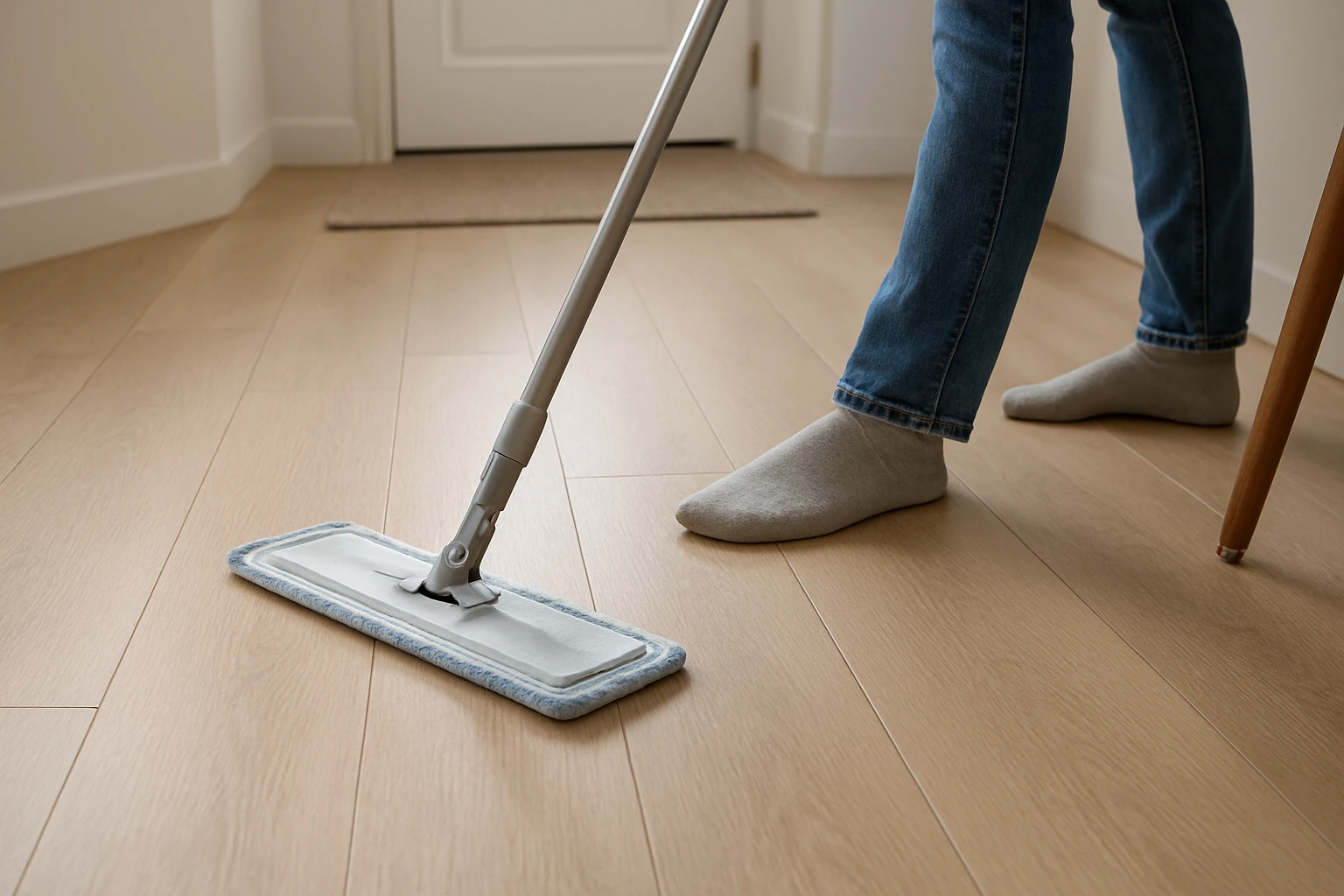
Sweep or vacuum with a suitable hard-floor head, then use a lightly damp microfibre mop and a cleaner approved for vinyl. Avoid abrasive pads, wax, and oil-based polish unless the manufacturer specifically allows them, because they can mark the surface or leave a slippery film.
Do not assume a steam mop is safe just because the box says “waterproof”. Heat and pressure can affect joints, adhesive, or surface layers, so use steam only if the product instructions clearly allow it.
For Dubai homes, keeping fine sand out is one of the most useful care steps. Use suitable entrance mats, clean them often, and lift furniture rather than dragging it. Check that mat backings are approved for vinyl, as some rubber-backed mats can cause staining.
Choose LVP when you value easy care, a warmer feel than tile, and a wood-style finish without timber maintenance. Compare it with carpet flooring when softness and a quieter room matter more, and with real wood when a natural surface and future refinishing are priorities.
The best purchase is not simply the plank with the longest warranty or thickest core. It is a floor rated for your room, fitted over a properly prepared base, with clear care instructions and a price that includes the work beneath the surface.
Frequently Asked Questions
Can LVP Flooring Be Installed Over Existing Tiles?
LVP can sometimes be installed over existing tiles if the tiles are firmly bonded, dry, and flat enough for the chosen product. Deep grout lines may need filling, especially beneath thin glue-down planks, because their outline can show through. Loose or cracked tiles need investigation, and the added height must not block doors or create unsafe transitions.
Does LVP Flooring Need to Acclimate Before Installation?
LVP needs acclimation when the manufacturer requires it, and the required time varies by product. Follow the stated storage temperature, room conditions, and instructions for keeping packs flat. In Dubai, do not move hot packs straight from a vehicle into an air-conditioned room and assume they are ready to fit.
Can You Use LVP Flooring with Underfloor Heating?
Some LVP products work with underfloor heating, but both the flooring and heating system must be approved for use together. Check the maximum permitted floor temperature, any underlay limits, and the instructions for raising and lowering the heat. Thick rugs or furniture with little clearance can trap heat, so ask about those restrictions before fitting.
Is LVP Flooring a Good Choice for Dogs?
LVP can be a practical floor for dogs because spills and muddy paw marks are usually easy to clean, but it is not scratch-proof. Choose a product rated for the expected use, keep nails trimmed, and consider a textured surface for better grip. Wipe up accidents promptly because liquid can still reach joints and room edges.
Does LVP Flooring Release Chemicals into Indoor Air?
LVP and installation adhesives can release small amounts of chemicals into indoor air, so product-specific emissions testing is worth checking. Ask for a recognised low-emissions certification, such as FloorScore, for the exact flooring product rather than relying on a general brand claim. Choose a suitable low-emissions adhesive where needed and ventilate the room during and after fitting.